


Rotary Hammer Safety: How Do You Control Silica Dust, Vibration and Kickback?
Last updated: September 21, 2026 · Reading time: 8 min · Written by the ETpower engineering team (Taizhou XuLi Machinery Co., Ltd.)
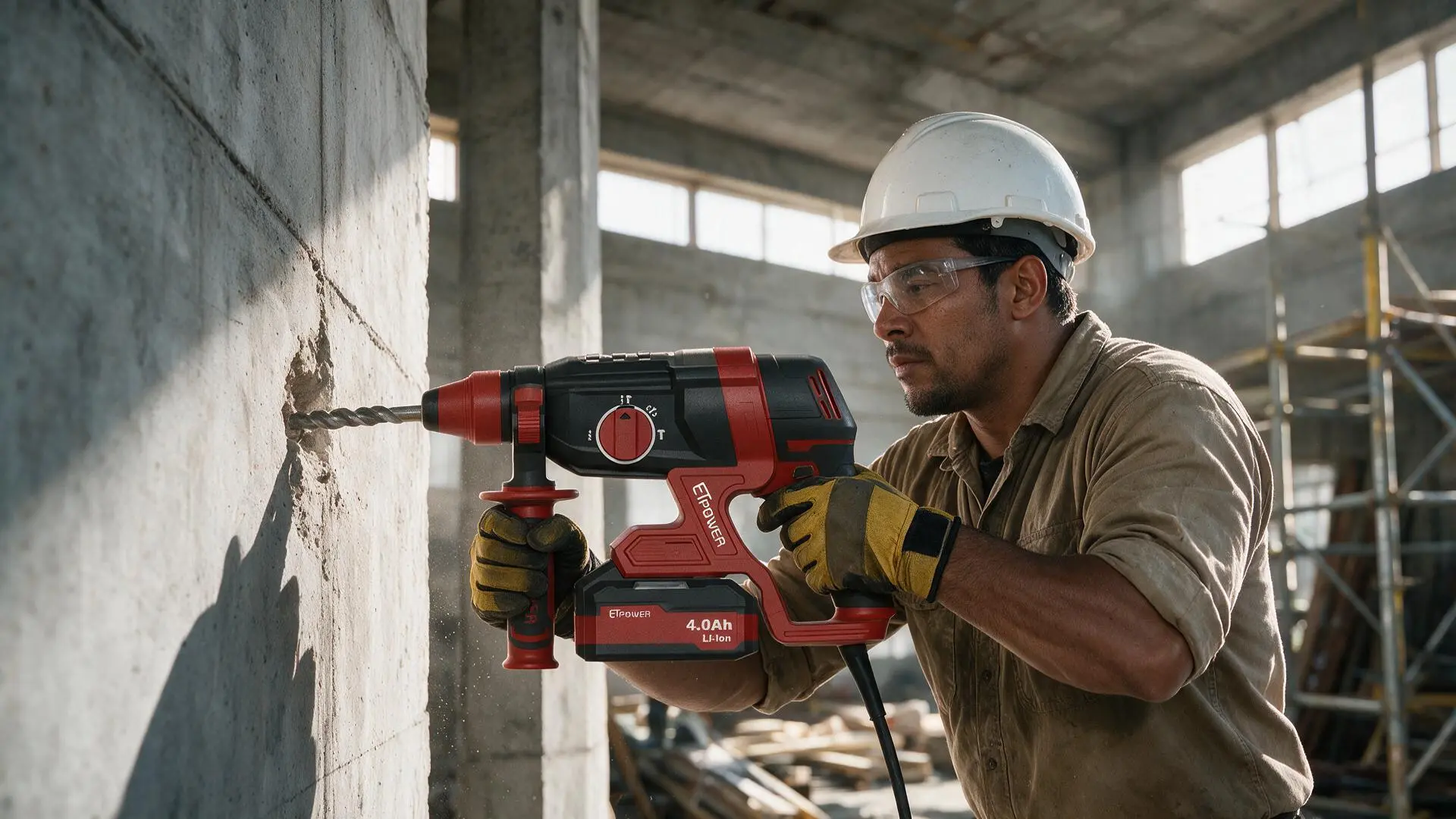
Nobody gets hurt by a rotary hammer in a single moment. The damage is cumulative: a lungful of dust here, two more hours of vibration there. By the time an operator feels it, the exposure is already years deep.
That is why this topic matters commercially, not just legally. Buyers in the EU, the UK, North America and Australia now screen suppliers on what comes in the box — a shroud, a vibration figure in the manual, a side handle that actually gets used. We build SDS-Plus Rotary Hammers in Taizhou and ship to 40 markets, so we have watched that shift first-hand. This guide lays out the three hazards and the controls that genuinely work.
Quick answer (TL;DR)
- Silica dust: capture it at the bit with an on-tool shroud and an M-class or HEPA vacuum. Water suppression is the alternative. Never dry-sweep or air-blow the dust.
- Vibration: manage trigger time, not willpower. Sharp bits, light grip, anti-vibration side handles, job rotation, and a class of tool matched to the hole.
- Kickback: two hands on the tool, side handle always fitted, sharp straight bit, and slow the feed rate on break-through.
- The cheapest safety upgrade is the right tool size. The smallest machine that drills the hole in good time produces the least dust, noise and vibration per hole.
1. The three hazards that actually end careers
Rotary hammer work exposes an operator to three slow-acting risks at once, and they are usually treated as one problem — which is why they are handled badly.
| Hazard | What causes it | What it does over time | Primary control |
| Respirable crystalline silica | Dust from drilling, chiseling and grinding concrete, brick and mortar | Silicosis, lung cancer, kidney disease | On-tool extraction or water suppression |
| Hand-arm vibration (HAV) | Prolonged grip on a hammering tool | Hand-arm vibration syndrome: numbness, loss of grip, white fingers | Trigger-time limits low-vibration tool |
| Kickback and crush | Bit binding, rebar contact, break-through | Acute wrist, hand and shoulder injuries | Two-hand technique side handle sharp bits |
2. Silica dust: the hazard you cannot see
Concrete, mortar and brick typically contain a large share of crystalline silica. Every impact from the piston fractures the material and throws off dust; the particles under 10 microns — respirable crystalline silica — stay airborne for a long time and reach the deepest airways. The coarse powder on the floor is the visible part. The fraction that harms people is the part you never notice.
The exposure numbers that decide your control
- OSHA (US): 50 µg/m³ respirable crystalline silica as an 8-hour time-weighted average. Table 1 of 29 CFR 1926.1153 gives a set of accepted work practices — for handheld hammers and drills, that means on-tool dust collection or water feed, plus specific housekeeping rules.
- EU / UK: a respirable crystalline silica occupational exposure limit in the order of 0.1 mg/m³ as an 8-hour average, with exposure reduced as far below the limit as reasonably practicable.
Controls, ranked by how well they work
| Control | Cuts dust where? | Practical notes |
| Shroud M-class / HEPA vacuum | At the bit | Best all-round choice. Requires a matched shroud and enough airflow; a clogged filter or kinked hose silently drops capture. |
| Water / wet drilling | At the bit | Very effective, but introduces slurry and electricity-in-wet-area considerations. |
| General ventilation / work area isolation | Room level | Useful in occupied buildings. Enclose the area, seal doorways, sign the entry. |
| Respiratory protection (FFP3 / N95 or better) | Individual | The last defence — not the first. Fit-tested masks only; a leaking mask gives false confidence. |
| Wet wipe, wet sweep or vacuum for clean-up | Housekeeping | Mandatory. Dry sweeping and compressed air re-aerosolise settled dust. |
One detail crews get wrong: dust control is only as good as the filter. A shroud connected to a household vacuum with a full bag captures almost nothing. Use a machine rated for the material, empty and maintain it, and check the seal on the shroud before every shift — the same way you would check a blade guard.
3. Vibration: think in trigger time, not in feelings
Hand-arm vibration is measured as an acceleration value in metres per second squared on a 8-hour reference period, written A(8). Regulators use two numbers:
- Exposure action value — around 2.5 m/s² A(8). Hit this and you must inform, train and start health surveillance.
- Exposure limit value — around 5 m/s² A(8). Never exceed it.
A rotary hammer can sit in the 8–15 m/s² range at the hands, which is why trigger time, not the tool alone, is what drives the dose. Two hours on one machine can be a full day's allowance; four hours is over it.
| Change this | Effect |
| Sharper carbide bit, correct type | A dull bit multiplies contact time and vibration. Cheapest control on site. |
| Correct tool size for the hole | No oversize tool to hold up, no undersize tool straining at full throttle. |
| Light grip, tool weight supported | Grip force is transmitted straight into the hands. Let the machine and the anti-vibration handle do the work. |
| Job rotation between trades | Exposure is a daily allowance; rotating tasks keeps every operator under it. |
| Warm, dry hands and gloves | Cold, wet hands lose circulation and show vibration damage sooner. Anti-vibration gloves help in part only — a rotary hammer vibrates mostly in a low-frequency band where gloves reduce less. |
4. Kickback and rotation: the hazard with no warning
Dust and vibration give you months of warning. Kickback does not. It happens when the bit suddenly stops turning in the material while the motor is still delivering torque, and the machine rotates instead — into the wrist, the shoulder, or the operator's foot if the tool is dropped.
The common triggers:
- The bit strikes reinforcing steel inside the concrete and grabs.
- The hole drifts off axis because the operator is leaning on the tool.
- The bit breaks through the far side of the wall and the flutes snag.
- The tool is used one-handed or without the side handle, so there is no reaction arm.
What we tell crews, and what we build our models around:
- Side handle on, both hands on. The auxiliary handle is not an accessory for big bits only; it is the reaction control for every hole.
- Use the mechanical safety clutch. Every ETpower rotary hammer carries a slip clutch that interrupts the drive when torque spikes. It reduces the risk, it does not replace technique.
- Keep the bit sharp and straight. A blunt or bent bit is the most predictable cause of binding.
- Ease off when breaking through. Reduce feed pressure in the last few millimetres of the wall.
- Never change a bit or clear a hole with the tool running, and never use a rotary hammer as a prying bar.
5. Tool class is a safety decision (20mm vs 26mm vs 28mm)
Here is the part most catalogues ignore: every hour you spend holding the wrong tool is an hour of unnecessary dust, noise and vibration.
| Class | Typical work | Exposure profile |
| 20mm, ~1.7–2.0 J | 6–16mm anchors, fixings, conduit in brick and block | Lightest tool, lowest recoil — the low-exposure default for light work. See the ETRH2-20 (500W, 1.7J). |
| 26mm, ~3.0 J | 16–26mm anchors, M12–M20 fixing, chiseling, tile and render removal | The volume workhorse. Fast enough that trigger time per hole drops sharply. See the ETRH2-26 (800W, 3.0J) and the full 26mm SDS-Plus rotary hammer category. |
| 28mm, ~3.2 J | Heavy anchors, pier pockets, sustained chiseling | More impact energy per blow means fewer blows and shorter hold times on hard concrete. See the ETRH2-28 (850W / 900W, 3.2J). |
The pattern is consistent: an undersized tool forces long trigger times, and an oversized tool adds weight, noise and recoil that the job never needed. Pick the class that matches the hole, not the biggest machine on the shelf. If you are still deciding, our SDS-Plus buying guide walks through the sizing logic, and the anchor installation guide shows the technique that goes with it.
6. What importers and distributors should ship with every tool
If you sell into markets with enforced silica and vibration rules, safety is now a procurement criterion — and a missed one costs you the tender. A compliant carton should carry:
- Side handle and depth gauge as standard, not as optional extras. A missing side handle is a finding in an EHS audit.
- A dust-shroud accessory that is genuinely compatible with the M-class vacuums sold in your market — hose diameter, adapter, and a note on airflow.
- A manual that declares vibration emission in m/s² and sound power, measured to the applicable standard, in the local language.
- Spare carbon brushes and a service interval table, because a worn tool vibrates more and drills slower.
- The right marks for your destination — CE and EAC where applicable, plus documentation your buyer can drop straight into a technical file.
- A PPE starter kit (FFP3 masks, glasses, ear plugs) as a shelf-ready bundle. In tenders, it is a small line item that wins goodwill and makes your product look finished rather than imported.
Pricing that bundle correctly means understanding MOQ, tooling and packaging costs. The Rotary Hammer OEM Sourcing Guide covers MOQ, lead time, Pantone matching and Incoterms; our company profile explains how we build private-label programmes from Taizhou.
7. Ten-point field checklist
- Shroud fitted, vacuum filter clean, hose not kinked.
- Respirator fit-checked on the operator's face.
- Bit sharp, straight, correct type and correctly seated in the chuck.
- Side handle tightened; both hands on the tool.
- Mode selector correct — hammer-only for chiseling, never chisel in rotary mode.
- Trigger time tracked against the daily allowance.
- Rotate tasks so no single operator takes a full dose.
- Work area sealed and signed in occupied buildings.
- Wet-wipe or vacuum clean-up at the end of the shift — never dry sweep or blow down.
- Tool logged for service: brushes, grease, chuck play, handle tightness.
8. FAQ
Is dust from a rotary hammer really dangerous?
Yes. Drilling and chiseling concrete releases respirable crystalline silica — particles small enough to reach the deepest part of the lung. The invisible fraction is the one that matters. OSHA limits exposure to 50 µg/m³ as an 8-hour average.
What is the most effective dust control when drilling?
On-tool extraction — a matched shroud plus an M-class or HEPA vacuum — captures the large majority of dust at the source. Wet drilling is a strong alternative where slurry is manageable. Dry sweeping and compressed air are never acceptable.
Do anti-vibration gloves make me safe?
No. They are tested to EN ISO 10819 and reduce transmission mainly in the mid and high frequencies, while rotary hammers vibrate strongly at low frequency. Trigger-time management and a well-matched tool do more than any glove.
What causes kickback on a rotary hammer?
The bit binding — hitting rebar, drifting off axis, or snagging on break-through. The tool's torque then spins the machine instead of the bit. Two-handed use with the side handle, sharp bits and a slower feed at break-through are the practical controls.
Does a bigger rotary hammer reduce exposure?
Only up to the point where it matches the hole. The lowest-exposure setup is the smallest tool that completes the work in a sensible time: no oversize weight and recoil, no undersize tool running at full throttle for twice as long.
9. Conclusion
Silica dust, hand-arm vibration and kickback are not separate problems — they are the price of holding a hammering tool for too long with the wrong setup. Fix the capture at the bit, match the tool class to the hole, and treat trigger time as a budget you spend deliberately. That single shift in thinking removes most of the risk, and it is also what makes a crew faster.
Specifying rotary hammers for a market with EHS requirements? Talk to our export team about shrouds, manuals and vibration declarations, or browse the full ETpower SDS-Plus range to see which classes fit your tender.
Request a Compliance-Ready Sample →
This article is maintained by the ETpower engineering team. Last reviewed on 21 September 2026. Exposure limits and regulatory references are summarised for practical guidance and may differ by jurisdiction and by revision date — always confirm against the current local regulation. For tool specifications, accessory compatibility and vibration declarations, request the current revision directly from our export team.


