-->
Rotary Hammer OEM Sourcing Guide: MOQ, Lead Time, Pantone (2026 Buyer's Playbook)
Last updated: September 11, 2026 · Reading time: 8 min · Written by the ETpower engineering team (Taizhou XuLi Machinery Co., Ltd.)
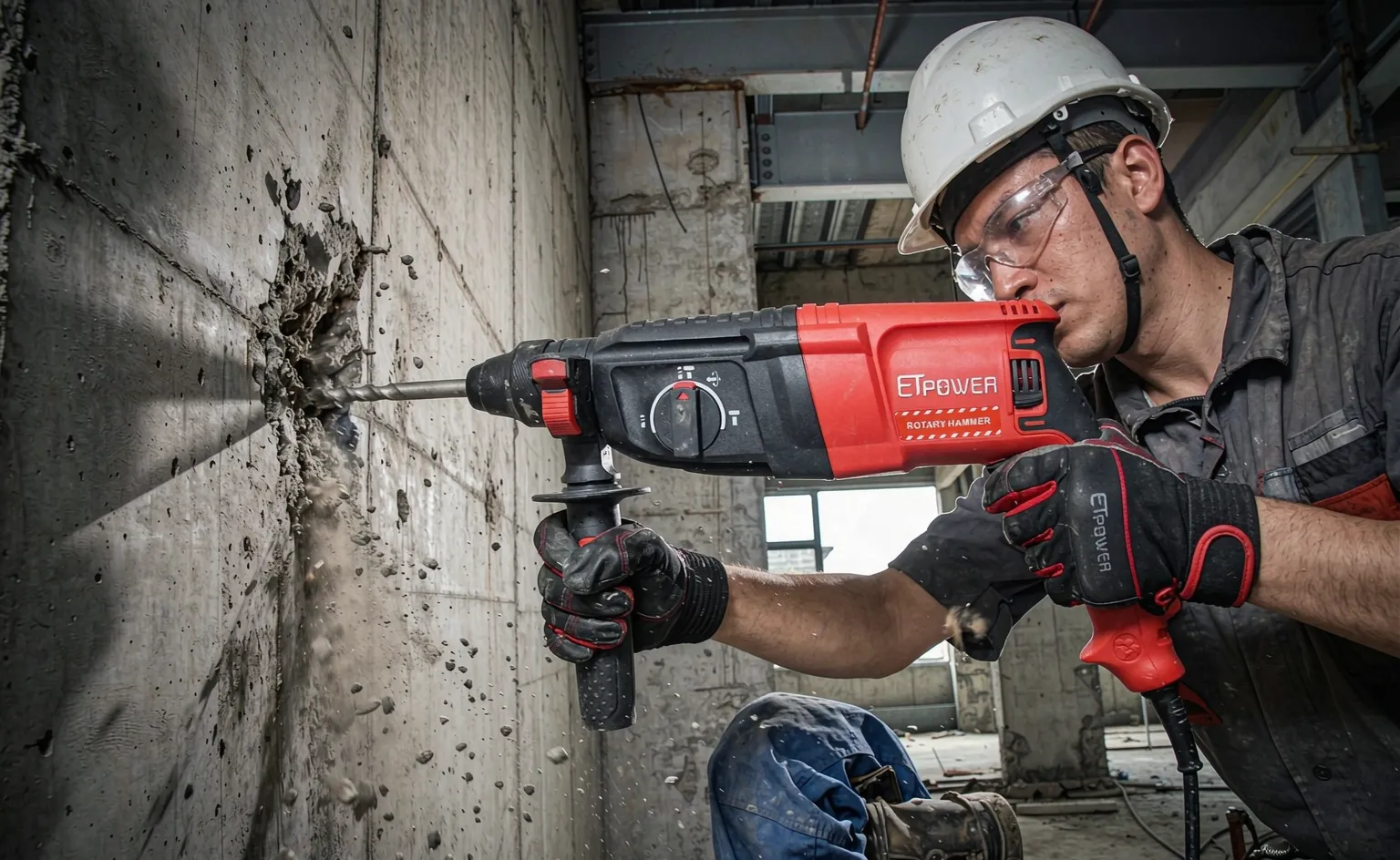
Sourcing rotary hammers from a Chinese OEM is one of the more profitable moves you can make as a power-tool distributor — and also one of the easiest to get wrong. The difference between a smooth first PO and a six-month headache usually comes down to ten things: MOQ, lead time, payment terms, Pantone tooling, voltage certification, owner's manual translation, barcode compliance, spare-parts supply, after-sales warranty process and shipping documents.
This guide is written by the team behind ETpower's rotary hammer export business — we've shipped private-label rotary hammers to Russia, Ukraine, Poland, India, Vietnam, Brazil and the Gulf states for ten years. Here is the workflow we run every importer through, the documents we ask for, and the things we tell our friends in the trade to check before they wire any money.
Quick answer (TL;DR)
- Standard MOQ: 500 pieces per SKU per shipment (mixable within a 26mm family container)
- Production lead time: 40 days from PO to ex-factory (5–7 days longer for first Pantone tooling)
- Shipping terms: EXW, FOB Ningbo or CIF your-port — your choice
- Customization: Pantone housing color, private-label packaging, region-specific voltage (110V or 220–240V), custom owner's manual, custom barcode
- Spare parts: 30-day rolling buffer for every active OEM SKU; gear sets, clutches, brushes ship within 48 hours
- Payment: 30% T/T deposit, 70% balance against B/L copy for first orders;
1. The 10-step OEM workflow at ETpower
Every OEM order at our factory goes through the same ten steps. Knowing this in advance is half the battle — you can plan your marketing, your warehouse and your after-sales support around it.
- Enquiry and spec sheet review. You send your target SKU, target retail price and target market; we send back our closest-fit model with a custom spec sheet within one business day.
- Sample approval. We ship a paid sample (typically USD 50–150 courier) within 5–7 days. You sign off on the sample in writing.
- Pantone packaging mock-up. For private-label orders, we send a artwork file for confirmation.
- Pro-forma invoice and PO. We issue a PI with the agreed specs, MOQ, lead time, payment terms and shipping terms. You counter-sign and send the 30% deposit.
- Production kickoff. We open a work order, the tooling team sets up the Pantone mixer, and the assembly line schedules your batch. Average setup time: 7-10 days.
- Pre-shipment sample. At 70% completion we photograph one pre-shipment sample so you can spot-check the color and finish before the full batch ships.
- QC inspection. AQL 2.5 inspection on cosmetic and functional defects; we share the inspection report and photos. You can also send your own inspector (most EU buyers do).
- Balance payment. You wire the 70% balance against a copy of the Bill of Lading.
- Container loading and shipping. We load the container, share the photos and the B/L. Vessel sails; ETA reaches your port 25–35 days later for ocean freight.
- After-sales and spare parts. We open a 30-day rolling buffer of spare parts for every active SKU. Warranty requests are processed within 48 hours; replacement parts ship the next business day.
2. MOQ — how low can you go?
The minimum order quantity is the OEM conversation nobody likes to have. At ETpower we run a tiered structure that maps to the four common buyer profiles:
- Trial order: 100 pieces per SKU, 30% higher unit cost. For distributors testing a new market before committing.
- Standard OEM order: 500 pieces per SKU per shipment, normal pricing. Mixable within a 26mm family container.
- Annual contract: 2,000 pieces per SKU per year, with quarterly releases. Lowest unit cost, custom color tooling waived.
- Tender / private-label launch: 1,000–3,000 pieces per SKU, mixed models, with custom packaging and manual included.
A practical tip from our export team: don't size your first order by your MOQ, size it by what you can sell in 90 days. We've watched too many first-time buyers over-order and end up discounting the second year.
3. Lead time — what 40 days actually means
"40-day lead time" is the headline number, but the breakdown matters more for your planning.
| Step | Days | What happens |
| Deposit PO confirmation | Day 0–7 | We open the work order, lock the line schedule |
| Tooling Pantone mix setup | Day 7–10 | Custom color mixer installed (first order only) |
| Component production | Day 11–25 | Housings, gears, motors, armatures built in parallel |
| Assembly line | Day 26–35 | Final assembly, label application, packaging |
| QC pre-shipment sample | Day 36–38 | AQL inspection, photos to buyer |
| Container loading B/L | Day 39–40 | Loaded, sealed, B/L issued |
On top of that, add ocean freight: 25–35 days to most EU, CIS and Latin American ports via Ningbo. Air freight is 5–7 days but costs roughly 4–6× ocean freight per kilogram — we recommend ocean for anything over 200kg and air only for emergency replacement orders.
If your market launch is on a fixed date, work backwards from there. For a September launch, your PO should land with us no later than mid-July for ocean freight, mid-August for air.
4. EXW, FOB or CIF — what the shipping terms actually mean
The three incoterms you'll be quoted are not interchangeable. Each one shifts a different set of responsibilities (and costs) between you and the factory.
- EXW (Ex-Works): We make the goods available at our Taizhou factory. You arrange pickup, export clearance, ocean freight, insurance and import clearance. Best for buyers with their own freight forwarder and a deep relationship with a customs broker.
- FOB (Free On Board, usually Ningbo): We deliver the goods onto the vessel at Ningbo port. You pay ocean freight, insurance and import clearance. Best for most first-time buyers — the factory handles a known cost, you control the ocean leg.
- CIF (Cost, Insurance, Freight): We pay for ocean freight and insurance to your named port. You pay only import clearance and last-mile delivery. Most expensive per unit, simplest for the buyer.
For first-time importers we recommend FOB Ningbo. It keeps the factory accountable for getting the container onto the ship, gives you visibility on the ocean freight cost, and lets you choose your own broker for import clearance.
5. Pantone color matching — what it costs and what it takes
Custom housing color is the single most visible piece of private-label work, and it's the first thing your customers will notice on the shelf. ETpower runs Pantone matching in batch sizes of 500 pieces.
How it works in practice:
- You send us your Pantone reference (e.g. Pantone 165 C for a safety-orange housing).
- We mix a batch sample and ship a color chip to your office for sign-off within 5-7 working days.
- If the color is acceptable, we lock the recipe; if not, we adjust and re-sample (one or two iterations is normal).
- On production, the mixer runs the locked recipe for the whole batch. AQL inspection checks color consistency on the line.
One-time tooling cost for a new Pantone is USD 250–400 depending on whether it's a simple housing color or a multi-tone design. This fee is typically waived against a 12-month supply contract of 2,000 pieces.
A practical warning from our QC team: Pantone color reproduction is sensitive to lighting. A chip that looks right under office fluorescents can look different under retail LED. Always ask for a photo of the chip under both light sources before sign-off.
6. Voltage certification — the most common customs headache
The single most common reason an OEM container gets stuck in customs is mismatched voltage documentation. Here's what to confirm before production.
- Confirm the target market's voltage: 220–240V / 50Hz for EU, CIS, India, Vietnam, Brazil and most of Asia; 110–120V / 60Hz for North America, parts of LatAm, Japan and Saudi Arabia.
- Match the motor label, the box and the spec sheet. If one says 220V and another says 230V, customs will pull the container for verification.
- Certify the plug type: EU Type F (Schuko), UK Type G, US Type B, Brazil Type N. The factory needs to source the right plug mould for each market.
- Ask for region-specific safety certs: CE for EU, EAC for Russia/Belarus/Kazakhstan, INMETRO for Brazil, BIS for India. ETpower ships pre-certified for the most common markets; new certs cost USD 1,500–3,000 and take 6–10 weeks.
This is also where a good OEM factory earns its keep. We maintain a database of motor label specs and plug moulds for 40 destination countries; ask your supplier the same question before you commit.
7. Owner's manual, barcode and compliance documents
Three compliance documents you'll need for every market, and what to budget for each.
For the owner's manual, always insist on a professional translation by a native speaker of the target language. A poorly translated manual is the single most common source of consumer complaints and warranty claims.
8. Spare parts — the question that separates good factories from bad ones
Here's the test question that every OEM buyer should ask, and that very few factory websites answer clearly: "What happens when my customer needs a replacement gear set in year three?"
At ETpower we keep a 30-day rolling buffer of spare parts for every active OEM SKU. The gear set, safety clutch, carbon brushes, switch assembly and motor armature are all field-replaceable with standard tools, and within 48 hours of a service request.
9. A practical ETpower SKU recommendation for new OEM buyers
If you're a first-time importer and you have to pick one container of rotary hammers to start with, this is what we recommend.
| SKU | Quantity | Why |
|---|---|---|
| ETRH2-20 (20mm) | 500 pcs | Volume seller, residential market entry |
| ETRH2-26 (26mm) | 500 pcs | Margin earner, tradesmen's primary tool |
| ETRH3-26 (26mm, refreshed) | 500 pcs | Premium SKU for design-conscious buyers |
That's one mixed container, one parts catalogue, three retail price points. Custom Pantone color included; private-label box and manual in your language included; 40-day production; FOB Ningbo. Our export team can have a pro-forma invoice and color sample in your inbox within three working days — drop us a line with your target market and we'll send the package.
10. FAQ
What is the MOQ for OEM rotary hammers?
At ETpower the standard MOQ for OEM rotary hammer orders is 500 pieces per SKU per shipment. You can mix SKUs within a container. For larger runs or repeat contracts the MOQ is flexible; for trial orders we ship as few as 100 pieces against a higher unit cost.
What is the typical lead time for a Chinese OEM rotary hammer order?
ETpower runs a 40-day production lead time from PO to ex-factory for standard OEM rotary hammer orders. Add 5–7 days for Pantone-matched color tooling on first orders, and 25–35 days for ocean freight to most EU / CIS / LatAm ports. Air freight is faster but 4–6× more expensive.
Can an OEM match Pantone colors on rotary hammers?
Yes. ETpower mixes Pantone-matched housing colors in batch sizes of 500 pieces. The setup cost covers a 5–7 day tooling window and a one-time fee that is typically waived against a 12-month contract. Send us your Pantone reference and we'll return a side-by-side color chip withinb five working days.
Do Chinese OEM rotary hammer factories supply spare parts?
Reputable ones do. ETpower keeps a 30-day rolling spare-parts buffer for every active OEM SKU — gear sets, chucks, safety clutches, switches, carbon brushes and motor assemblies ship within 48 hours from our Taizhou warehouse. Always confirm spare-parts supply before you place the first PO.
11. Conclusion
Sourcing rotary hammers from a Chinese OEM is a margin-positive move for almost any power-tool distributor — but only if you choose a factory that can manage the full workflow: spec confirmation, Pantone matching, voltage certification, owner's manual translation, spare-parts supply and after-sales support. The cheapest quote rarely is.
If you're starting a private-label rotary hammer programme, our recommendation is to begin with a mixed container of 500 × ETRH2-20 500 × ETRH2-26, in your Pantone, in your language, on a 40-day production cycle. Send us your target market, retail price band and Pantone reference and we'll come back with a sample, a spec sheet and a pro-forma invoice within three working days.
This article is maintained by the ETpower engineering team. Last reviewed on 11 September 2026. OEM terms, MOQ and lead times mentioned are accurate as of the review date and may evolve with product line updates. For a current spec sheet and pro-forma invoice, always request the latest revision directly from our export team.