


-->
How to Choose an SDS-Plus Rotary Hammer for Concrete — A Practical 2026 Buyer's Guide
Last updated: September 11, 2026 · Reading time: 7 min · Written by the ETpower engineering team (Taizhou XuLi Machinery Co., Ltd.)
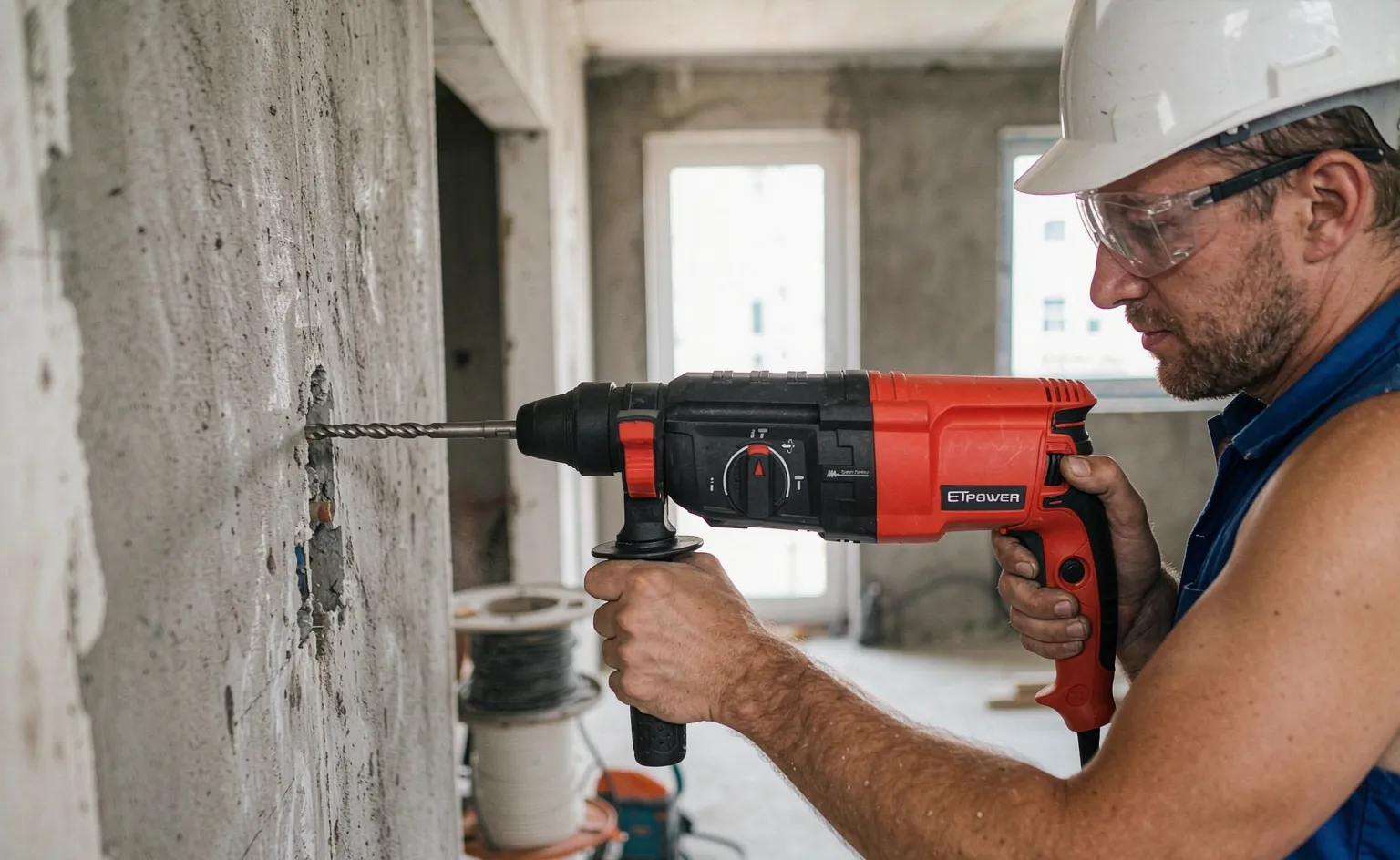
If you've ever stood in front of a wall of cured concrete with a drill bit in one hand and a catalogue in the other, you already know the feeling: there are too many tool sizes, too many wattage numbers, and not enough plain-English advice. Buy too small and you'll burn through a job site. Buy too big and you've overpaid for capability you won't use.
This guide is written by the team behind ETpower SDS-Plus rotary hammers, manufactured in our own factory in Taizhou, China. We walk you through the four specs that actually matter for concrete — impact energy, bit shank size, motor wattage and chuck type — and we end with a short pick-list for the two SDS-Plus sizes we ship most often: the 20mm class and the 26mm class.
Quick answer (TL;DR)
- For light residential work (anchors up to 10mm, brick chasing, light tile removal) — pick a 20mm SDS-Plus rotary hammer such as the ETpower ETRH2-20, 500 W motor, 1.7 J impact energy.
- For daily site work and trade (12–26mm anchor holes, conduit runs, chiseling) — pick a 26mm SDS-Plus rotary hammer such as the ETpower ETRH2-26, 800 W motor, 3.0 J impact energy, three operating modes.
- Match the tool to the bit, not the other way around. All SDS-Plus bits fit both sizes; the bigger tool just delivers more impact energy per blow.
- Skip the wattage race. 500 W vs 800 W tells you nothing on its own — what matters is the Joule rating on the box.
1. The four specs that actually matter for concrete
Power-tool catalogues love to throw numbers at you: RPM, BPM, voltage, frequency, peak torque, blow count, no-load speed. Most of those are noise. When you drill concrete, only four numbers decide how the tool performs.
1.1 Impact energy (Joules) — the single most important spec
Impact energy measures how hard the piston inside the rotary hammer hits the back of the drill bit per stroke. It is the difference between a tool that spins against concrete and a tool that fractures concrete.
| Impact energy class | Typical use on concrete | Example ETpower model |
| 1.5 – 2.0 J | 6–12mm anchor holes, brick chasing, light tile chiseling | ETRH2-20 (1.7 J) |
| 2.5 – 3.5 J | 12–26mm anchor holes, conduit runs, window frame installation, chiseling | ETRH2-26 / ETRH3-26 / ETRH4-26 / ETRH5-26 (3.0 J) |
| 3.5 – 4.5 J | M16 structural anchors, light demolition | ETRH2-28 (3.2 J) |
For most residential and light-commercial work, 3.0 J is the sweet spot. Below 2.0 J you'll find yourself leaning on the tool and burning bits; above 4.0 J the tool gets heavy and the vibration will tire out a DIY user.
1.2 Bit shank — SDS-Plus is the only sensible answer
SDS-Plus is the universal chuck system for Rotary Hammers up to about 28mm drilling capacity. The bit slides in, locks with a click, and the piston can hit it directly instead of fighting a tightened chuck. SDS-Plus also lets the bit move slightly back-and-forth on its own — that's what creates the hammering action while the drill rotates.
If a catalogue lists "keyed chuck" or "keyless chuck" on a tool advertised as a "concrete drill", it's almost certainly a hammer drill, not a rotary hammer. It will spin slowly through masonry and overheat within minutes on a 16mm hole.
1.3 Motor wattage — useful but not decisive
Wattage tells you how much electrical power the motor can draw continuously. A 500 W motor in a well-designed 20mm tool will out-perform a 1500 W motor in a poorly designed 26mm tool. Use wattage as a tie-breaker between two similar models, not as your first filter.
One practical warning for OEM buyers: motor wattage is what customs and shipping paperwork usually care about. Make sure the rating on the box matches the rating on the motor label and the rating in the spec sheet — different numbers on different documents will cause headaches at the port of entry.
1.4 Operating modes — drill, hammer drill, hammer only
Most SDS-Plus rotary hammers in the 20–28mm class offer three modes selected by a rotary collar on the side of the housing:
- Drill only — pure rotation. Use for wood, metal, plastic.
- Hammer drill — rotation plus impact. This is the mode you'll use 90% of the time for concrete.
- Hammer only — pure impact, no rotation. Use with an SDS chisel for tile removal, channel chasing, light demolition.
The 20mm ETpower ETRH2-20 ships with two modes (drill hammer drill). All 26mm and 28mm ETpower models add the third hammer-only mode, which is what makes them useful for chiseling.
2. Match the tool to your scenario
Specs matter, but they only earn their keep on a real job. Here are the four most common concrete scenarios we hear about from ETpower distributors, and the tool we recommend for each.
2.1 Anchor bolt installation in cured concrete
This is the bread and butter of any SDS-Plus rotary hammer. M8 to M16 anchors — the most common sizes in residential and light commercial work — call for a tool that:
- Drills 8–18mm holes cleanly through cured 25–30 MPa concrete
- Delivers at least 2.0 J per stroke so the bit doesn't bog down on rebar-adjacent zones
- Has a safety clutch so the bit stops if you hit rebar or a void (the clutch saves the gearbox and your wrist)
For M8–M10 anchors in brick or block, the ETpower ETRH2-20 20mm class tool is sufficient. For M12–M16 anchors in cured concrete, step up to any 26mm class tool — the ETRH2-26 is the workhorse, the ETRH4-26 adds a beefed-up safety clutch, and the ETRH5-26 uses an extended-life gear set for high-frequency daily drilling.
2.2 Window and door frame installation
Window fitters drill dozens of 10–14mm anchor holes per install, typically through brick or cured concrete lintels. This is where the third hammer-only mode becomes useful — after drilling the anchor hole you can swap to an SDS chisel and clean out the window recess in seconds.
For a one-person window-fitting business, the ETRH4-26 26mm rotary hammer with the enhanced safety clutch is the right pick. The clutch is what saves your wrist when a 14mm bit suddenly hits a hidden piece of steel.
2.3 Tile and thin-brick removal
Tile removal is where rotary hammers earn their second life. With a 40mm flat SDS chisel and the hammer-only mode, you can strip 1 m² of ceramic tile from a concrete substrate in about 10 minutes — without breaking the substrate itself, which is what a demolition hammer tends to do.
For light-duty tile removal (kitchens, bathrooms) the 20mm ETRH2-20 is fine. For whole-floor tile removal on a renovation project, the 26mm class — particularly the ETRH3-26 with its refreshed housing — is what we recommend to our own OEM distributors.
2.4 Electrical conduit and pipe runs
Electricians and plumbers drill dozens of small holes (6–12mm) through concrete walls and floors to run conduit or pipe clips. The temptation is to grab a small hammer drill. Don't — you'll be there all day and the motor will run hot. A 20mm SDS-Plus rotary hammer in the hammer-drill mode will cut your drilling time by 3 to 5 times.
For electricians, the ETpower ETRH2-20 is the classic pick. It weighs under 3 kg, fits in a tool bag alongside your pliers and side cutters, and runs an entire house rewire on a single 1.7 Joule impact class.
3. Decision flowchart — pick the right ETpower SDS-Plus rotary hammer
Use this quick mental flowchart when you're standing in the warehouse aisle:
- What's the largest hole you'll drill in concrete?
- ≤ 12 mm → 20mm class (ETRH2-20)
- 13–26 mm → 26mm class (ETRH2-26 / ETRH3-26 / ETRH4-26 / ETRH5-26)
- 27–32 mm → 28mm class (ETRH2-28)
- Will you chisel or just drill?
- Just drill → 20mm is enough
- Drill chisel → 26mm class (need the third mode)
- How often will you drill per week?
- Occasional DIY (under 5 hours/week) → ETRH2-20 or ETRH2-26
- Daily site work (5–25 hours/week) → ETRH3-26 or ETRH4-26
- Heavy rental / industrial (25 hours/week) → ETRH5-26 with extended-life gears
- What voltage and plug do you need?
- EU / CIS / most of Asia → 220–240 V / 50 Hz
- North America / parts of LatAm → 110–120 V / 60 Hz
That last point catches a lot of OEM buyers. The motor label and the spec sheet must both show the same voltage; mismatched documentation can hold up customs clearance. ETpower ships every model in both voltage variants on request — see our OEM/ODM page for the full regional cert list.
4. Buying from ETpower: what to expect as an OEM distributor
If you're an importer, distributor or private-label buyer, our process is the same whether you're sourcing one container of 20mm tools for a regional hardware chain or a year-long supply contract for 26mm tools under your own brand:
- MOQ: 500 pieces per SKU per shipment
- Lead time: 40 days from purchase order to ex-factory
- Terms: EXW, FOB or CIF — your call
- Customization: Pantone-matched housing color, private-label packaging, region-specific voltage and plug, custom owner's manual
- Spare parts: 30-day rolling buffer for every active OEM SKU; gear sets, chucks, switches and field-serviceable parts ship within 48 hours
To see the full OEM workflow and request a side-by-side spec sheet for the 20mm and 26mm classes, head to our company profile page or contact our export team.
5. FAQ
What size SDS-Plus rotary hammer do I need for concrete?
For anchor holes up to 12mm, picture hooks and light brick chasing, a 20mm SDS-Plus rotary hammer such as the ETpower ETRH2-20 (1.7 J) is enough. For 12–26mm anchor holes, conduit runs, window frame installation and chiseling, step up to a 26mm class tool such as the ETRH2-26, ETRH3-26, ETRH4-26 or ETRH5-26 — all rated 3.0 J.
Is SDS-Plus mandatory for concrete drilling?
For regular work on cured concrete, yes. SDS-Plus lets the piston transfer impact energy directly to the bit, drills 3 to 5 times faster than a clutch-type hammer drill and accepts purpose-made masonry bits. A keyed-chuck hammer drill will burn out its motor on sustained concrete use.
How much impact energy do I need for reinforced concrete?
Cured concrete of 25–30 MPa is the typical site baseline, and a 2.0–3.0 Joule SDS-Plus rotary hammer handles it comfortably. For reinforced concrete where you occasionally hit rebar, look for 3.0 J or higher plus a safety clutch — both of which come standard on the ETpower ETRH2-26 series.
Can I use the same drill bits across 20mm and 26mm SDS-Plus rotary hammers?
Yes. SDS-Plus is a standard shank — every ETpower 20mm, 26mm and 28mm model accepts the same SDS-Plus bits, chisels and core cutters up to the rated capacity of the tool. That simplifies stocking for contractors and OEM distributors.
6. Conclusion
Choosing the right SDS-Plus rotary hammer for concrete is not about buying the biggest motor or the highest RPM. It's about matching impact energy to the hole size you'll drill most often, confirming the chuck is genuine SDS-Plus, and buying from a manufacturer who can keep spare parts flowing for the next ten years.
For most users the choice is between the 20mm ETRH2-20 (light residential work) and the 26mm ETRH2-26 (daily site work). If you're a distributor, our four-variant 26mm lineup gives you four price points to cover four market segments with one common parts inventory.
Still not sure which ETpower model fits your scenario? Send our export team the largest hole size, your weekly drilling hours and the country you ship to — we'll reply with a one-page spec recommendation within one business day.
This article is maintained by the ETpower engineering team. Last reviewed on 11 September 2026. Specifications and OEM terms mentioned are accurate as of the review date and may evolve with product updates. For the latest spec sheet, always request the current revision directly from our export team.


